
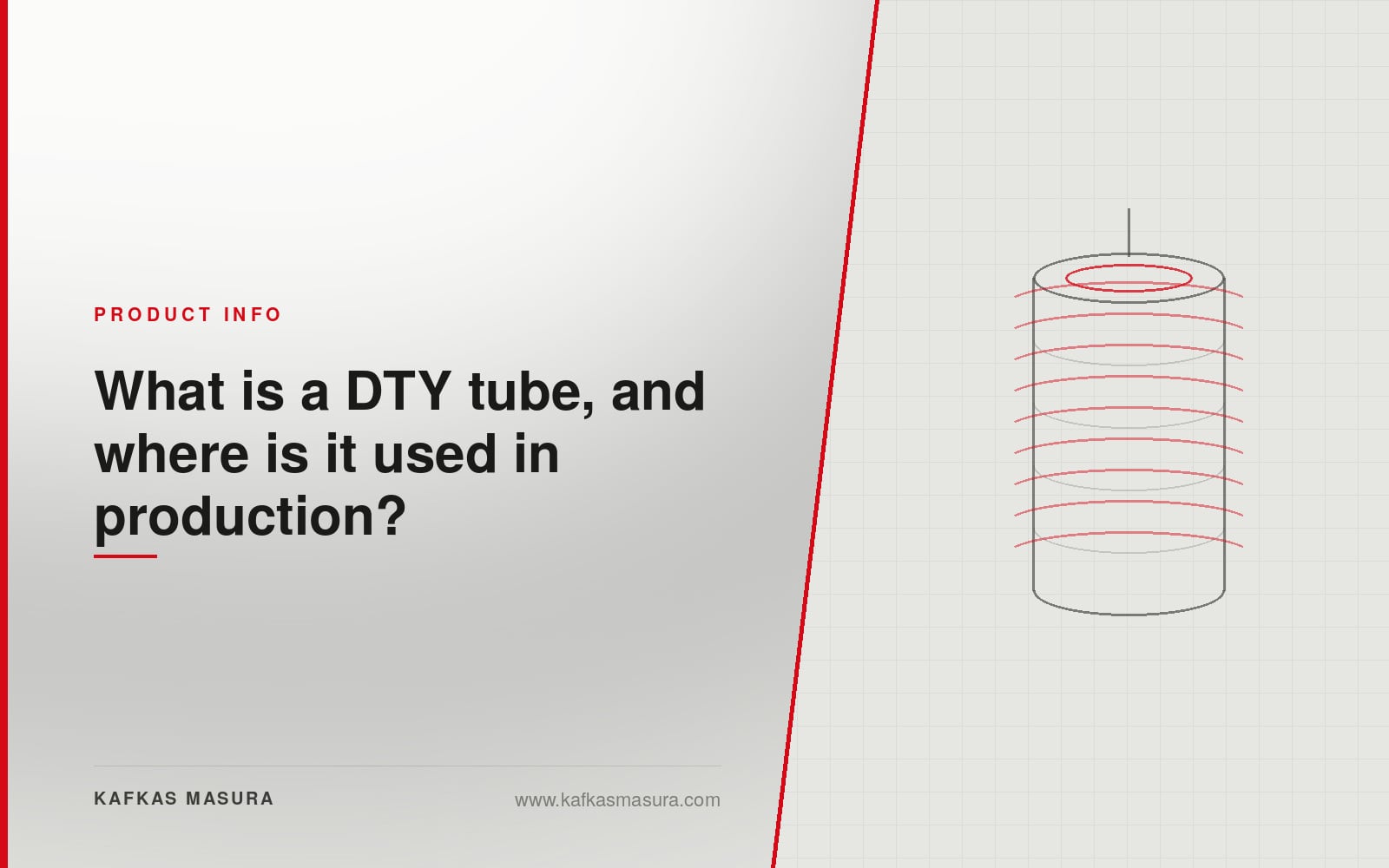
A DTY tube takes its name from the yarn wound onto it. Understanding what that yarn is and how it is produced also explains what is expected of the tube.
What is DTY?
DTY is short for Draw Textured Yarn. It is obtained by putting synthetic filament yarn through drawing and texturing processes.
Synthetic yarn production is broadly a two-stage affair. In the first stage the polymer is melted, extruded through spinnerets into filaments and wound — this intermediate product is POY. In the second stage the POY is drawn on a texturing machine and given bulk through heat and twisting. The result is DTY.
What does texturing do?
Flat filament yarn feels plastic to the touch and has no bulk. Texturing gives the filaments a permanent crimp. The result:
- The yarn gains bulk and covering power
- It gains elasticity
- Its surface takes on a handle closer to natural fibre
- Moisture and air permeability improve
These properties make DTY a widely used yarn in apparel, home textiles and upholstery fabrics.
What is expected of the tube at the DTY stage?
At the texturing output the yarn is wound at high speed under a defined tension. At this stage the tube is expected to deliver the following.
Dimensional stability
The tube must hold its roundness throughout winding. In a tube that ovalises, the winding geometry breaks down, the package does not form correctly and unwinding problems appear at the next process step.
Surface smoothness
Roughness or burrs on the tube surface can damage the yarn in the first winding layers. With fine denier yarns this risk increases.
End integrity
Tube ends must be cleanly cut and free of crushing. A crushed end affects both the first and last layers of the winding and causes problems when mounting on the spindle.
Moisture balance
Paperboard changes in dimension and strength when it takes up moisture. Storage conditions are therefore part of product quality.
How it differs from a POY tube
POY and DTY tubes may look as though they do the same job, but the conditions at the two stages differ. Package weights and tension values differ in POY winding; on the DTY side, winding speed and yarn characteristics change.
For this reason the dimensions and wall strength of the tubes used at the two stages are generally not the same. For a detailed comparison, see our article on POY tubes.
DTY tubes at Kafkas Masura
Our DTY tubes are made of paperboard and produced in custom sizes, to order. Inner diameter, length and wall thickness are determined according to your texturing machine, your winding tension and the weight of your full package.
Contact us to confirm dimensions or to request a sample.