
A paper tube looks like a minor consumable in yarn winding. Yet when its dimensions are wrong, it directly affects line speed, waste levels and shipping safety. In this article we look at the three dimensions that define a tube and what determines each of them.
The three core dimensions
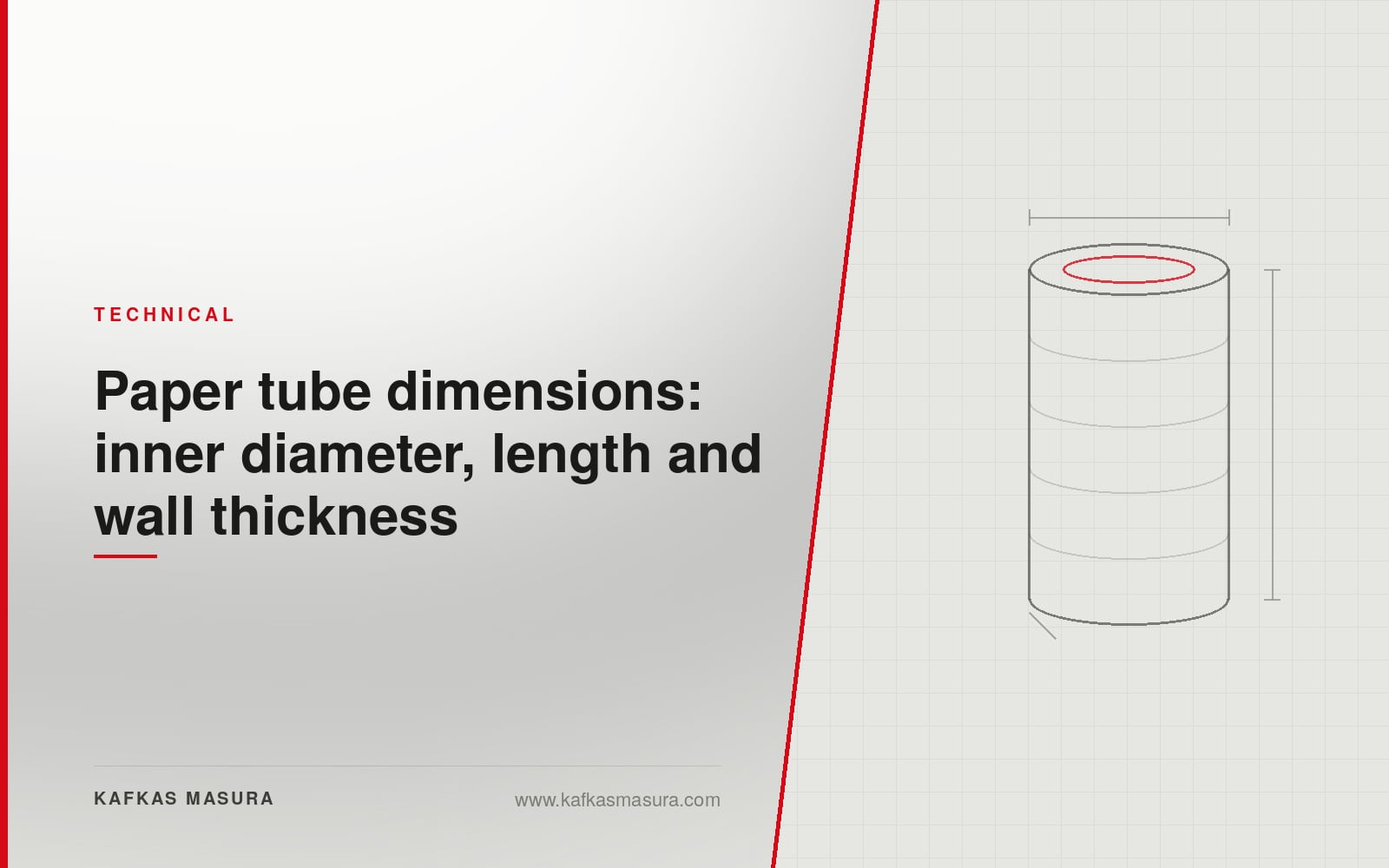
A tube is defined by three dimensions:
- Inner diameter — the diameter of the hole through the tube
- Length — the length of the tube
- Wall thickness — the thickness of the paperboard wall
Outer diameter is not an independent dimension; it follows from the inner diameter and the wall thickness. A tube with a 30 mm inner diameter and a 4 mm wall has an outer diameter of 38 mm.
What determines the inner diameter?
The inner diameter is set by whatever the tube mounts onto: the spindle of the winding machine, the carrier in the creel, or the adapter in use.
Tolerance is critical here. If the inner diameter is too tight, the tube will not go onto the spindle, or will only go on under force; either way the operator loses time. If it is too loose, the tube moves on the spindle, the winding drifts off centre and the package does not form correctly.
For this reason the inner diameter is never given as an approximation. It is set from the spindle diameter of the machine and its working tolerance.
What determines the length?
Length is set by the winding width. Whatever width the wound yarn occupies, the tube length should match it.
If the tube is too long, empty sections remain at its ends; these take knocks during handling and stacking and get crushed. If it is too short, the yarn overruns the end of the tube and the winding breaks down.
In some applications a tube a few millimetres longer than the yarn is chosen deliberately, to protect the yarn ends. That choice varies with the product type and the next process step.
What determines the wall thickness?
Wall thickness is the dimension that determines the strength of the tube. Three factors are decisive:
- Winding tension. Yarn is wound onto the tube under tension. That tension applies a continuous inward pressure. The higher the tension, the thicker the wall required.
- Full package weight. With heavy packages the tube carries both its own load and the weight stacked above it.
- Stacking and handling. In the warehouse, tubes in the lower rows of a stack see the highest load.
If the wall is too thin the tube ovalises during winding and the winding geometry of the yarn breaks down. If it is unnecessarily thick, material has been wasted and weight and cost have gone up.
The dimensions are not independent
These three dimensions do not carry meaning separately; they only make sense together. A long tube tends to flex more than a short one at the same tension, which is why longer tubes generally have thicker walls.
Likewise, as the inner diameter grows the circumference increases and the same wall thickness provides less resistance.
If you do not know your dimensions
If you have a tube in use, establishing its dimensions is straightforward:
- For the inner diameter, measure the hole with callipers
- For the length, measure the tube end to end
- For the wall thickness, take a cross-section, or subtract the inner diameter from the outer diameter and halve the result
If these measurements are not available, the make and model of your machine and the type of yarn being wound also point the way.
The Kafkas Masura approach
The tubes we manufacture are produced in custom sizes, to order. You are not obliged to fit a standard catalogue size; the right dimensions for your machine and your yarn are determined together with you.
Share the dimensions of your current tube, a photograph of it, or details of your machine, and we can confirm the right product.